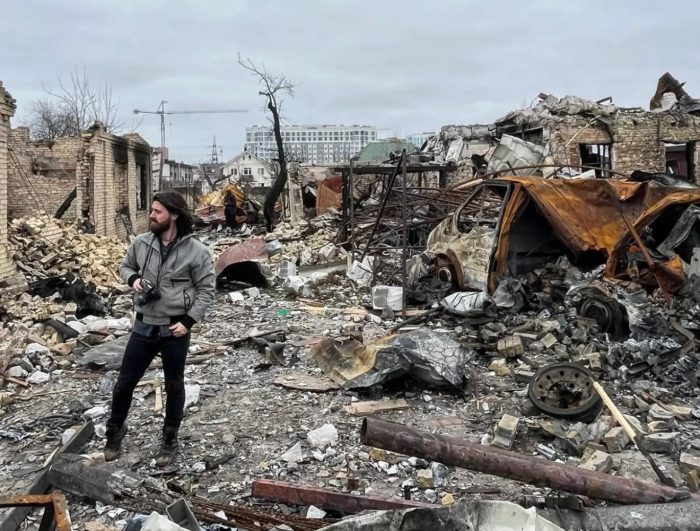
New Zealand-born freelance journalist Tom Mutch has spent several years reporting from Ukraine, documenting the war with rare tenacity. His new book, The Dogs of Mariupol, offers a deeply human account of the invasion, through the eyes of soldiers, civilians, and those caught between. With bylines in The Times, The Telegraph, The Daily Beast, and elsewhere, he speaks to AOAV’s Iain Overton about trauma, resilience, and Ukraine’s emerging identity in the shadow of war.
Iain Overton: Why did you choose the title The Dogs of Mariupol?
Tom Mutch: It comes from one of my clearest memories just before the full-scale invasion. I was in Mariupol in early 2022. Though fighting had simmered since 2014, there was a feeling something worse was coming. You could hear occasional mortar fire in the distance.
What stayed with me most was the behaviour of the street dogs. They were agitated, aggressive—biting and snarling at each other. It was like they sensed the war before it began. I even tweeted about it at the time. There’s an old superstition that dogs bark when death is near.
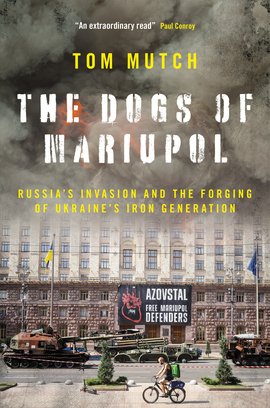
A month later, I heard from the woman who had been my hotel receptionist. She’d escaped Mariupol in the same convoy as AP journalists Evgeniy Maloletka and Mstyslav Chernov. She later gave me her diary, 20 days of hell, which became a core part of the book. But those dogs—that image never left me. That’s why they’re on the cover. Also, it’s a reminder that many of Mariupol’s defenders are still in Russian captivity. And we may never know the true number of dead.
Iain Overton: You describe the emergence of an “Iron Generation” in Ukraine. What defines them?
Tom Mutch: The name came from an embed I did with a National Guard unit in Donbas. The people there were extraordinary—PhD students, philosophers, even one of Zelensky’s former bodyguards. They were young, talented, and had all chosen to fight. Later, Ursula von der Leyen spoke of Ukraine’s “golden generation.” I thought the metal was wrong. Gold is soft. These people are forged—hardened by fire.
What they do after the war remains an open question. There’s already tension between those who served and those who didn’t, between women who stayed and those who left. That could shape a more militarised society, perhaps like Israel, where national service is the norm. But it could also lead to something more hopeful. We just don’t know yet.
Iain Overton: You write with emotional force but also journalistic control. How did you handle that balance?
Tom Mutch: Writing a book is different from writing a dispatch. When I file for The Daily Beast or The New Zealand Herald, readers expect a neutral tone. But when it’s a book with your name on the cover, readers expect something deeper. So I allowed myself to include personal reflections—but always with a clear line between what I saw and how I interpreted it. That gives you more freedom to explore.
Iain Overton: The book includes stark critiques of both Russian aggression and Ukrainian missteps. Were you under pressure to soften your reporting?
Tom Mutch: One of the admirable things about Ukraine is that there’s still space for internal criticism. Sure, press officers sometimes want to shape the narrative. But off the record, people were open. I got access to senior officials, even cabinet members, and never felt I had to self-censor.
That said, I’m not a marquee name from The New York Times. There’s probably more scrutiny on those journalists. I do know Ukrainian colleagues who’ve faced pressure, particularly over sensitive military information. But I didn’t experience that personally.
Iain Overton: At what point did you feel you’d become more than a foreign correspondent—part of the place, almost?
Tom Mutch: I couldn’t write this book in Ukraine. I had to return to New Zealand. I needed distance—geographically and emotionally. But when you stay that long, something shifts. You begin to identify with the people, even while keeping some journalistic detachment.
A lot of foreign journalists, aid workers, volunteers feel the same. We know Ukraine’s flaws. But I don’t know anyone who spent serious time there and came away cynical about it. That says something.
Iain Overton: Was there a moment when your belief in Ukraine’s victory faltered?
Tom Mutch: There were two moments. One was when Zelensky came to Kherson after its liberation. He held a small press conference—maybe 20 of us. Someone asked, “Is this the beginning of the end?” and he said, “Yes.”
Later, we were stuck on a bus at the edge of town, taking photos near a column. Suddenly, bang—a massive artillery round landed about 100 metres away. People started shouting, “Get on the bus, now!” It was a jarring reminder that the war wasn’t over.
A few months later, I was in Bakhmut. That’s the hinge of the book. Morale was low, soldiers were exhausted, people were openly criticising command. It didn’t feel like victory was near. But Ukraine has defied expectations again and again. Russian advances remain limited.
Iain Overton: How did you decide what to include in the book—especially the most distressing scenes?
Tom Mutch: I thought hard about how to show what had happened in places like Bucha and Izium. There’s a danger of becoming voyeuristic or sensationalist. I included some reflections on this—one chapter is called The Vulture Club, a term used for war correspondents who descend on atrocity sites.
I worried about exploiting personal trauma. In some cases, I removed details at people’s request. But those images were part of why I stayed. Ukrainians wanted the world to know what they endured.
And I wanted to show how war warps reality. I remember a woman at a museum in Izium saying, “We’ll visit the mass graves, be back at the bus by 1pm.” Like it was a school trip. That juxtaposition—horror and routine—haunted me.
Iain Overton: What’s the geopolitical legacy of this war for nuclear non-proliferation?
Tom Mutch: Devastating. Many Ukrainians now say they wish they’d kept their nuclear arsenal. Realistically, that may not have been possible, but symbolically, the Budapest Memorandum feels like a betrayal. The West promised security in exchange for disarmament. That promise failed.
The lesson—whether in Kyiv or Tripoli—is: don’t disarm. Dictators around the world are watching this and drawing their own conclusions. They’ll point to Bucha and say, “This is what happens if you trust the West.”
Iain Overton: And the image that lingers most?
Tom Mutch: The dogs. Always the dogs.
But also a woman I met in a Kyiv bar just before the invasion. A year and a half later, I saw her again in Bakhmut—now a soldier. Same red nails, even in the trenches. Her boyfriend, a drone pilot, was later killed. She wanted his story told too. And that’s what this book tries to do.
Iain Overton: Where can people find it?
Tom Mutch: It’s in Waterstones, some Daunt branches, and on Amazon UK. There’ll be an international edition later this year.
Did you find this story interesting? Please support AOAV's work and donate.
Donate