A brief history of gun branding and product placement in Western cinema
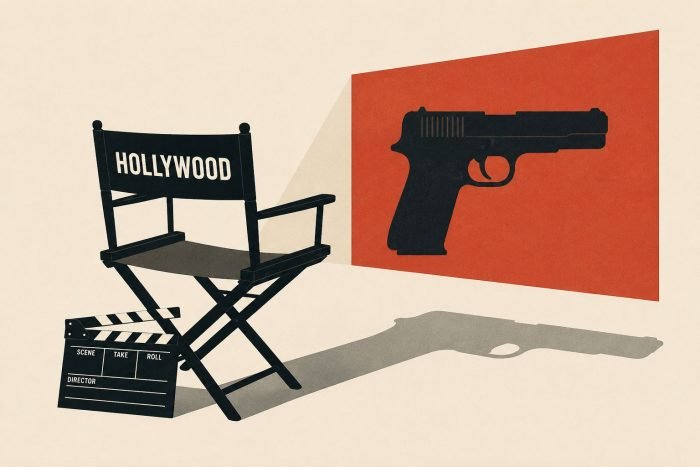
The presence and stylised representation of guns in Hollywood is a phenomenon witnessed as early as the 1900s. From Porter’s 1903 Great Train Robbery ending with a straight gun shot at the camera, to Stallone’s 1986 Cobra gun-into-camera introduction, guns have long been not only present but central to characters’ identity construction (Lapierre and Sada Garibay 2025, p. 1; Mattes 2013, p. 460)
For decades, Hollywood has contributed to the transformation of guns from instruments into symbols of status and vehicles of aspiration and power. These early depictions of guns and gun violence laid the groundwork for the aestheticised violence that now permeates contemporary cinema.
The centrality of guns to so many films and characters has reshaped the way audiences understand guns and gun violence, raising important questions about gun branding and product placement. To advertise a gun is not an easy feat, as most traditional advertising spaces have strict policies in place to restrict their promotion due to their ability to be construed as “threatening, violent, or expressly emblematic of political ideology” (Drenten et al. 2023, p. 96). Nevertheless, other avenues have been established in place of these official channels, with cinema among them. Hollywood has been an important vehicle for the gun manufacturing industry to promote its products beyond the typical clientele (e.g., military and security forces).
However, speaking of guns in the context of product placement is tricky, as little verifiable evidence exists of direct collaborations between firearm companies and filmmakers. What is more verifiable is the impact Hollywood has had on popularising certain gun models and manufacturers.
A few key examples highlight this relationship. German pistol producer Carl Walther reportedly travelled to the set of James Bond movies to hand over his PPK and P99 models (Deckert, 2008); the PPK would later become one of the most recognised handguns globally, akin in incredible cultural cachet. Austrian firearms company Glock’s encouragement of prop masters to use their guns led to their inclusion in Die Hard 2 and Edge of Darkness, catapulting sales and popularity to the point that some automatically associate handguns with Glocks (Anderton, 2018). The use of Smith and Wesson’s .44 Magnum Model 29 in Dirty Harry led to an explosion in sales, exemplifying the power of this kind of advertising (Mattes, 2013). Stallone’s bespoke Colt Gold Cup in Cobra, together with the film’s tagline, ‘Crime is a disease. Meet the cure’, positioned the weapon as a symbol of virtue and heroism. The use of the Beretta 92 in Die Hard (1988) and Lethal Weapon (1987) brought significant global cultural capital to Beretta (NRA Museum). More recently, the John Wick franchise features an arsenal of firearms, from Glock models to the Thompson M1A1 submachine gun and the Webley .455 Mk VI (Friedrich, 2024), celebrating bespoke arsenals, tactical shooting culture, bespoke arsenals, and presenting guns as instruments of artistry and discipline.
The blurred lines between advertising and entertainment
Although proof may be limited, the positive effects on sales are similar to those observed in known cases of—less dubious—product placement in cinema. Often cited as the first modern case of product placement, Hershey’s Reese’s Pieces saw a 65% increase in sales following their use in the 1982 film E.T. (Hudson and Hudson 2006, p. 491). Plenty of examples of product placement and its positive effects on manufacturers exist; hence, it is hard to imagine the gun industry, with its limited advertising capacity, has not capitalised on this.
Traditional product placement for firearms is heavily restricted, with most media prohibiting gun advertisements. Cinema, however, appears to operate in a regulatory grey zone, with the depiction of firearms generally not subject to the same disclosure expectations or public scrutiny that have developed around tobacco product placement (Kovalenko, 2013, p. 19-22). The lack of formal contracts between filmmakers and gun manufacturers means that both Hollywood and gun manufacturers can plausibly deny active involvement in promoting gun violence, whilst still benefiting from the advantages of embedding gun brands into films (Pulliam, 2012). Unlike traditional advertising, which is clearly labelled and subject to scrutiny, gun placement in film operates invisibly, exposing audiences to messages that raise ethical questions; namely, about how this influences real-world attitudes towards guns and violence (Sharma and Bumb, 2020).
However, the cinematic portrayal of firearms extends beyond simple product recognition.
Films rarely depict guns as neutral tools; instead, they serve as potent symbols of power, masculinity, and moral authority (Jeffords, 1994, p.24-63). This emphasises the aesthetic that the audience is not just seeing a weapon but also understanding it as a marker of strength, independence, and mastery of threat. Hollywood thus promotes not only firearms but also identity. This process reflects McCracken’s (1989) theory of meaning transfer, in which the symbolic attributes associated with a celebrity or fictional character are transferred to the products they use. This transfer of qualities influences audience perceptions and emotional responses. In the context of action films, the firearm inherits the qualities of its owner rather than vice versa. The appeal of these firearms, therefore, lies less in their mechanical design than in the identities they represent. Consumers are not merely purchasing a weapon; they are purchasing a symbolic connection to the hero who made it iconic.
Firearms also transform the balance of power within a story. A character who begins vulnerable or outmatched often gains control once armed, enabling them to confront stronger adversaries and restore justice. Repeated exposure to these narratives may encourage audiences to associate firearms with empowerment, independence, and the ability to overcome threats. Although viewers understand that these stories are fictional, the symbolic relationship between guns and personal agency can persist beyond the screen (Bushman and Huesmann, 2006).
Importantly, not all firearms carry the same symbolic meaning. The moral identity of a weapon is shaped by the character who wields it. At the same time, the villain’s weapon becomes a symbol of fear or oppression. It is this symbolic transformation, rather than the weapon itself, that helps explain why certain firearms become iconic and desirable among audiences.
Perhaps no franchise illustrates this phenomenon more clearly than James Bond. Since the early 1960s, Bond’s association with the Walther PPK has transformed an otherwise conventional handgun into one of the most recognizable firearms in popular culture. The pistol functions not merely as Bond’s weapon of choice but as an extension of his identity, reinforcing his image as sophisticated, capable, and morally justified in his use of violence.
James Bond and the globalisation of gun branding
Thanks to its consistent association with the James Bond universe, the Walther PPK is perhaps one of the most iconic firearms in cinematic history. As a symbol of British intelligence excellence, Bond exalts sophistication, masculinity, and modernity through the use of professional, powerful weapons such as the Walther PPK (Bolton, 2011, p. 278-282). Consequently, the weapon’s association with the franchise led to sales skyrocketing in the U.S., which had previously been mostly limited to government contracts (Small Arms Review, 2009).
Bond is a character whose DNA encapsulates an ideal of masculinity and power so perfectly that whatever product is linked to him is bound to explode among audiences looking to emulate these values. He has become an archetypal hero that is seen as “what every man would like to be and what every woman would like to have between her sheets” (Chandler 2011, xiii cited in Coghlan, Hackett, and Nolan 2023, p. 4). A character of this power can only be accompanied by an equally powerful and stylish weapon; enter the Walther PPK.
The switch to the PPK is a pivotal moment in the character’s development; up until 1958, Bond had carried a “rather lady-like” Beretta .25 (Small Arms Review, 2009). At the suggestion of Geoffrey Boothroyd, a firearms expert who wrote to Ian Fleming speaking of a more powerful, manly pistol, the Bond author ditched the Beretta .25 and introduced the Walther PPK (Coogan, 2022). When the gun is first introduced to the audience, a detailed explanation of its benefits is provided: “Walther PPK. 7.65 mm, with a delivery like a brick through a plate glass window. Takes a Brausch silencer with very little reduction in muzzle velocity. The American CIA swear by them” (Wells, n.d).
Connecting the weapon to the CIA and security forces ensures the audience understands its exclusivity, prestige, and power — and implicitly encourages those who want to be just as powerful and respected as Bond to acquire it. Whereas previously the Walther PPK was found only in the hands of professional security forces, today collectors and Bond enthusiasts contribute significantly to sales and the aestheticisation of this particular gun model (Szondy, 2020).
The way forward: public health implications and the need for transparency
The way guns have been incorporated into film plots has contributed not just to sales but to the rise of aestheticised violence, with Dan Baum (2013) explaining just how well film positions guns as an appealing and thrilling part of the story. He observes:
The camera adores everything about the gun—the flash, the smoke, the menacing slick-click of a hammer being cocked, the power the gun bestows upon the weak to inflict third-reel redemptive violence on the strong. Movies don’t need guns to be exciting but add a gun to story and the emotional temperature rises. (p. 102)
This cultural conditioning has profound implications for public health and public attitudes towards firearms. Research in media psychology has consistently demonstrated that repeated exposure to violence can contribute to desensitisation and shifts in normative beliefs about acceptable behaviour (Krahe et. al. 2011). Whilst establishing a direct causal link between watching action films and engaging in gun violence remains difficult, the influence on attitudes is well-documented. Studies into guns in particular directly link them to aggression, with their mere presence being enough to trigger this reaction. Bushman et al. (2013) examine this psychological phenomenon—the “weapons effect”—particularly in the context of top-selling films. Their findings reveal that by showing gun violence in films, the industry may contribute to a strengthening of the weapons effects and to giving audiences, especially younger and more impressionable ones, a step-by-step guide on how to use guns (p. 1014).
A controlled experimental study by Dillon and Bushman (2017) examined how exposure to gun-related film scenes affects children’s behaviour and perception of firearms. Children, like adults, are often fascinated by how firearms are portrayed in films, but unlike adults, they may have greater difficulty distinguishing fictional portrayals from appropriate real-world behaviour. As a result, they may imitate the actions of admired characters when given the opportunity, making media portrayals of firearms especially influential during childhood. Dillon and Bushman (2017) found that children aged 8–12 who watched film scenes containing guns were not more likely to locate or pick up a concealed firearm. However, they were 22 times more likely to pull the trigger than those who watched the same scenes without guns. The study also found that these children handled the firearm for significantly longer periods, with a median duration of 53 seconds compared to 11 seconds in the control group (Dillon and Bushman, 2017). The authors conclude that “children who view film scenes with guns in them will hold a real gun longer and will pull the trigger more times compared with children who see the same movie scenes not containing guns” (Dillon and Bushman, 2017). For young audiences, whose cognitive and behavioural regulation systems are still developing, these findings suggest that such portrayals may have meaningful behavioural effects.
The normalisation of gun culture through cinema takes on additional urgency in the American context. Whilst most countries have strict civilian firearm ownership laws, the same cannot be said in the United States, the home of Hollywood and one of its biggest audiences. The increase of firearm ownership as a result of aestheticised gun violence is worrying enough, but the often-unrestricted access to firearms by children in the country may be an even bigger issue (Miller, 2023). Hollywood’s normalisation of gun culture and violence directly contributes to the US’ long struggle to control gun violence, with the country recording “more than 90% of all youth firearm deaths that occur in high-income countries” (Khubchandani 2017, p. 67).
Beyond cinema itself, the digital amplification of gun culture through social media platforms demands attention. Hollywood is not alone in inadvertently (or advertently) promoting guns, as today’s phenomenon of social media influencers has now expanded beyond the fashion and fitness realm to talk about gun ownership and promote an ideology linked to the US Constitution’s Second Amendment (2A ideology) (Hernandez, 2023). Doctors Huff and Barnhart from Oregon State University’s College of Business speak of ‘gunfluencers’ and social media posts linking guns to masculinity, with one stating, “consider your man card reissued.” Others encourage the purchase of guns through military imagery, so that civilians can feel a kinship with these men through the same weaponry (Ibid). Moreover, a study of “Twitter and YouTube posts by gun manufacturers and by influencers found that the top 12 influencers had 6.1 billion channel views, compared to 98 million views of manufacturers’ content” (Jordan et al., 2020). Rather than relying on traditional advertising, firearm-related messages are increasingly disseminated through influencers whose audiences view them as relatable and trustworthy. This allows discussions of gun ownership to become integrated into everyday social media content, making firearms appear as ordinary lifestyle items rather than inherently dangerous weapons. For young viewers especially, the line between entertainment, education, and marketing becomes indistinct, with guns presented as objects of technical fascination and aesthetic appeal rather than instruments of lethal force (Ibid).
Conclusion
The relationship between Hollywood and gun manufacturers operates largely beyond regulatory and public scrutiny. Evidence of direct partnerships is practically non-existent, and the two reap the benefits without much accountability. From the Walther PPK to the idea of bespoke arsenals, Hollywood elevates guns from functional objects to aspirational symbols, woven seamlessly into narratives of power, masculinity, and justice.
With gun violence a leading cause of death in the U.S. and increasing worldwide, the public health costs of Hollywood’s relationship with guns are high and warrant policy consideration. The implications of this phenomenon extend beyond branding and consumption, potentially influencing public policy and regulation. Evidence from media psychology suggests that repeated exposure to stylized gun violence can shape normative beliefs, influence behavioral responses, and contribute to the desensitization of audiences, particularly among younger viewers.
While causal pathways between screen violence and real-world gun use remain complex and contested, the consistent association of firearms with empowerment, heroism, and control raises important public health considerations. Greater transparency is essential to addressing the risks posed by gun placement in cinema. Moreover, with new social media trends taking shape (e.g., the spread of gunfluencers and 2A ideology), it is important to encourage interdisciplinary research to begin to untangle the seductive mythology of the gun from its devastating human consequences.
Bibliography
- Anderton, F. (2018) ‘America is the gun: do movies provide the branding?’, KCRW, 28 February. Available at: https://www.kcrw.com/shows/design-and-architecture/stories/america-is-the-gun-2013-do-movies-provide-the-branding (Accessed: 21 October 2025).
- Baum, D. (2013) Gun guys: a road trip. Vintage.
- Bolton, L. (2011) ‘Christopher Lindner (ed.) (2009) The James Bond Phenomenon: A Critical Reader, 2nd edn’, Film-Philosophy, 15(1), pp. 278–282. https://doi.org/10.3366/film.2011.0021
- Bushman BJ. & Huesmann LR. (2006) Short-term and Long-term Effects of Violent Media on Aggression in Children and Adults. Arch Pediatr Adolesc Med. 160(4):348–352. doi:10.1001/archpedi.160.4.348
- Coghlan, J., Hackett, L.J. and Nolan, H. (2023) The world is not enough: The impact of James Bond on popular culture. International Journal of James Bond Studies, 6(1). https://doi.org/10.24877/jbs.93
- Coogan, J. (2022) Bond’s Walther PPK Backstory | Field Ethos. Field Ethos. Available at: https://fieldethos.com/bonds-walther-ppk-backstory/
- Deckert, R. (2008) “Bad Company” and “Bad Boys”: Heckler & Koch in Hollywood’, Berlin Information-Center for Transatlantic Security. Available at: https://www.bits.de/public/articles/kw_nl/kleinwaffen-nl06-08eng.htm (Accessed: 20 November 2025).
- Dillon, K. P., & Bushman, B. J. (2017) Effects of exposure to gun violence in movies on children’s interest in real guns. JAMA pediatrics, 171(11), pp.1057-1062. https://doi.org/10.1001/jamapediatrics.2017.2229
- Drenten, J., Gurrieri, L., Huff, A.D. and Barnhart, M. (2024) Curating a consumption ideology: Platformization and gun influencers on Instagram. Marketing theory, 24(1), pp.91-122. https://doi.org/10.1177/1470593123120732
- Friederich, B. (2024) ‘How a master firearms engraver made the John Wick 4 dueling pistols’, Maxim, 16 February. Available at: https://www.maxim.com/gear/how-a-master-firearms-engraver-made-the-john-wick-4-dueling-pistols/ (Accessed: 17 November 2025).
- Hernandez, R. (2023) ‘Think Out Loud: gun sales advertising’, Oregon Public Broadcasting, 14 November. Available at:https://www.opb.org/article/2023/11/14/think-out-loud-gun-sales-advertising/ (Accessed: 22 November 2025).
- Hudson, S. and Hudson, D. (2006) Branded entertainment: a new advertising technique or product placement in disguise?. Journal of Marketing Management, 22(5-6), pp.489-504. https://doi.org/10.1362/026725706777978703
- Jeffords, S. (1994) Hard Bodies: Hollywood Masculinity in the Reagan Era. New Brunswick, NJ: Rutgers University Press. pp.24-63
- Jordan, L., Kalin, J. and Dabrowski, C. (2020) Characteristics of gun advertisements on social media: systematic search and content analysis of Twitter and YouTube posts. Journal of medical internet research, 22(3). http://doi.org/10.2196/15736
- Khubchandani, J. (2017) Adolescent homicides, suicides, and the role of firearms: A narrative review. American Journal of Health Education, 48(2), pp.67–79. https://doi.org/10.1080/1932503 7.2016.1272507
- Kovalenko, Andriy. (2013) Disclosure of the Persuasive Intent behind the Placement of Risky Products in Movies: Consequences for Cognitive and Affective Processing, pp.19-22. https://doi.org/10.13140/RG.2.2.24331.44320
- Krahé, B., et. al. (2011) Desensitization to media violence: links with habitual media violence exposure, aggressive cognitions, and aggressive behavior. Journal of personality and social psychology, 100(4), 630–646. https://doi.org/10.1037/a0021711
- Lapierre, M.A. and Sada Garibay, C. (2025) Shooting Movies: Effects of Gun and Firearm Exposure in Popular Films on Gun Use Self-Efficacy and Gun Attitudes/Beliefs. Journalism & Mass Communication Quarterly. https://doi.org/10.1177/10776990251331624
- Mattes, A. (2013) Turning the gun on America: Cobra and the action film as cultural critique. Australasian Journal of Popular Culture, 2(3), pp.457-470. https://doi.org/10.1386/ajpc.2.3.457_1
- McCracken, G. (1989) Who is the Celebrity Endorser? Cultural Foundations of the Endorsement Process. Journal of Consumer Research, 16(3), pp.310–321. http://www.jstor.org/stable/2489512
- Miller, J. (2023) The Health and Economic Toll of Gun Violence in Youth | Harvard Medical School. hms.harvard.edu. Available at: https://hms.harvard.edu/news/health-economic-toll-gun-violence-youth.
- Miller, K. (2018) Hollywood Wants Gun Control — For Everyone But Them. Refinery29.com. Available at: https://www.refinery29.com/en-us/2018/01/185256/gun-control-hollywood-violence-in-film-problem.
- NRA Museum. (no date) ‘Die Hard (1988) Beretta 92FS’, Hollywood Guns. Available at: https://www.nramuseum.org/the-museum/the-galleries/william-b-ruger-special-exhibits/hollywood-guns-4/die-hard-%281988%29-beretta-92fs.aspx (Accessed: 23 October 2025).
- Pulliam, Maria Flavia T. (2012) “Product Placement Decisions On-Set.” Thesis, Georgia State University. https:// doi.org/10.57709/3459296
- Sharma, S., & Bumb, A. (2022) Product placement in entertainment industry: a systematic review. Quarterly Review of Film and Video, 39(1), pp.103-119. https://doi.org/10.1080/10509208.2020.1811606
- Small Arms Review. (2009) ‘James Bond’s bantam banger: the Walther PPK’, Small Arms Review, December. Available at: https://smallarmsreview.com/james-bonds-bantam-banger-the-walther-ppk/ (Accessed: 24 November 2025)
- Szondy, D. (2020) The Walther PPK, the classic spy gun that changed the game. New Atlas. Available at: https://newatlas.com/technology/walther-ppk-classic-spy-gun-history/
- Wells, J. (no date) ‘Walther PPK pistol James Bond 007: how and when gun’, The Gentleman’s Journal. Available at: https://www.thegentlemansjournal.com/article/walther-ppk-pistol-james-bond-007-how-when-gun/ (Accessed: 17 November 2025).
Did you find this story interesting? Please support AOAV's work and donate.
Donate