Since May 2024, the so-called “humanitarian zone” in Gaza—an area designated by the Israel Defense Forces (IDF) as a refuge for civilians—has been subjected to 97 strikes, according to a detailed investigation by BBC Verify. This devastating revelation raises significant questions about the safety and efficacy of such zones in a region where conflict and violence show no sign of abating, as well as the behaviour of the IDF for allowing this to happen.
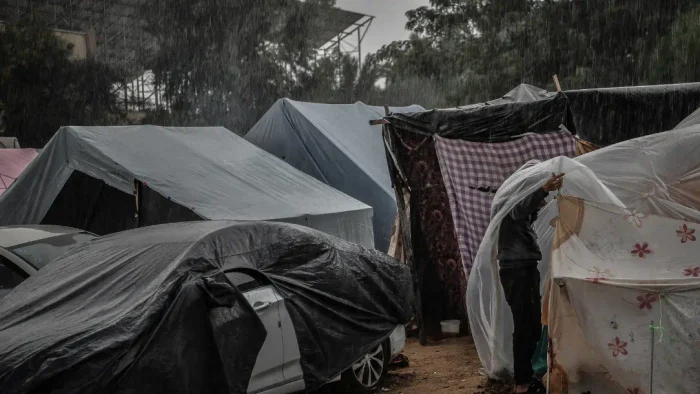
These strikes have caused over 550 fatalities, many of whom were women and children, and left countless others injured or displaced.
The Creation and Expansion of the ‘Humanitarian Zone’
The IDF first established the humanitarian zone in October 2023, presenting it as part of a broader effort to shield civilians amid the escalating conflict with Hamas. This zone was significantly expanded in May 2024 to include the cities of Khan Younis and Deir al-Balah, areas that have since become focal points of displacement for over a million people.
The majority of those living in the zone reside in makeshift tents, with limited infrastructure and minimal access to essential aid. International humanitarian organizations have described the conditions as dire, with residents lacking adequate shelter, clean water, and medical supplies.
However, even within the boundaries of this so-called safe haven, civilians face a daily threat of violence. BBC Verify’s analysis highlights that the humanitarian zone has been repeatedly targeted by airstrikes, artillery fire, and drone attacks. This reality underscores the challenges of ensuring civilian protection in one of the most densely populated regions in the world.
Civilian Casualties and Escalating Violence
The attacks on the humanitarian zone reflect a broader pattern of escalating violence in Gaza. Action on Armed Violence’s (AOAV) Explosive Violence Monitor 2024 has documented a 67% global increase in civilian casualties from explosive violence compared to 2023. Gaza remains the epicenter of this crisis, accounting for 39% of all civilian casualties recorded globally in 2024.
Airstrikes have proven particularly devastating, responsible for 63% of all civilian casualties worldwide last year. AOAV’s data reveals that the lethality of airstrikes has doubled, with a 104% increase in civilian deaths and injuries attributed to such attacks in 2024 compared to 2023. In Gaza alone, over 33,900 civilian casualties were recorded in 2024, a staggering 139% rise from the previous year.
The IDF has claimed that its operations within the humanitarian zone target Hamas fighters and infrastructure, accusing the group of using civilians as human shields and launching rockets from densely populated areas. In a statement to BBC Verify, the IDF emphasized that its strikes were aimed at “terrorists and terror infrastructure.”
However, local reports and testimonies paint a different picture. Residents and humanitarian workers describe near-daily bombardments that frequently result in civilian casualties. Khaled Abdel Rahman, a resident of the zone, told the BBC: “We were displaced to Khan Younis because it was designated as a safe zone, but in fact, we find nothing here but insecurity. Fear dominates our lives.”
Hospitals and medical facilities have also come under fire, with nine strikes recorded near Al-Aqsa Hospital in Deir al-Balah and four near the Nasser Medical Complex in Khan Younis. The IDF maintains that these strikes targeted legitimate military objectives, but the proximity of these attacks to vital civilian infrastructure raises serious concerns about compliance with international humanitarian law.
Shifting Boundaries and Uncertainty
One of the most troubling aspects of the humanitarian zone is the lack of stability in its boundaries. Since its creation, the zone’s size and scope have been altered 20 times, with residents often receiving little notice of these changes. Evacuation orders have become a common occurrence, forcing families to relocate repeatedly under harrowing conditions.
Despite the IDF’s assurances that residents can return to evacuated areas once the danger has passed, the lack of clear communication has left many in a perpetual state of uncertainty. The humanitarian zone’s fluctuating boundaries have eroded trust and undermined its credibility as a genuine safe haven.
The attacks on Gaza’s humanitarian zone are part of a larger pattern of explosive violence that has had devastating consequences for civilians worldwide. AOAV’s data shows that air-dropped bombs have increased by 355% globally between 2023 and 2024, driven by their use in Gaza, Ukraine, and Myanmar. This surge highlights the growing reliance on airpower in modern conflicts, often with catastrophic consequences for civilian populations.
In Gaza, the sheer scale of destruction is evident in satellite imagery, which shows entire neighborhoods reduced to rubble. The ongoing conflict has displaced hundreds of thousands of people, creating a humanitarian crisis of unprecedented proportions.
International Response and the Need for Accountability
Despite the mounting civilian toll, international efforts to address the crisis in Gaza have been limited. The UN and other humanitarian organisations have repeatedly called for an end to the use of explosive weapons in populated areas, emphasizing that there is no such thing as a truly “safe zone” in Gaza.
Juliette Touma, a spokesperson for the UN agency for Palestinian refugees, stated: “There is no safe zone in Gaza. No place is safe. No one is safe. No place is spared.”
AOAV echoes these sentiments and calls for immediate action to protect civilians. The use of explosive weapons in densely populated areas violates international humanitarian law and exacerbates the suffering of vulnerable populations.
Did you find this story interesting? Please support AOAV's work and donate.
Donate