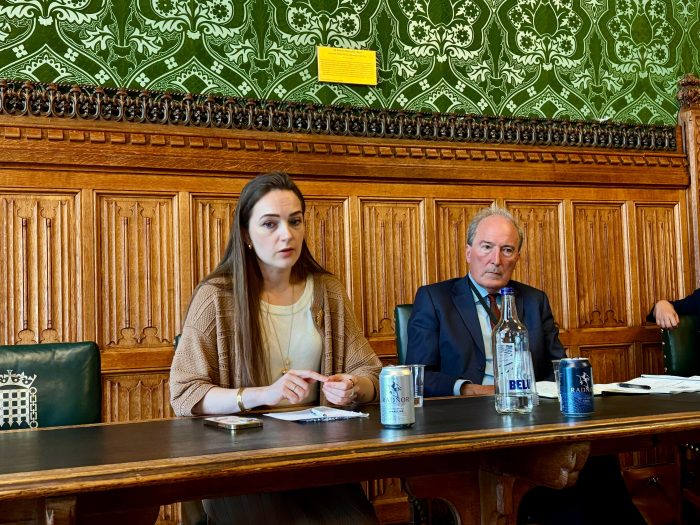
On 12 June 2025, Ukrainian human rights lawyer Oleksandra Matviichuk addressed a packed Committee Room in the Houses of Parliament. Matviichuk, whose human rights organisation Center for Civil Liberties was the co-recipient of the 2022 Nobel Peace Prize, spoke clearly and directly: “Without justice, there can be no peace—not for Ukraine, and not for the world.”
The event, chaired by Baron Moore, then English journalist and the chairman of The Spectator, aimed to refocus political and media attention on the human consequences of Russia’s war in Ukraine.
Since the full-scale invasion in February 2022, Matviichuk’s legal team has documented more than 88,000 potential war crimes. But as she told the audience, documentation alone is not enough. “There’s a painful gap between what has been documented and what has been prosecuted,” she said.
Matviichuk’s appearance in Westminster was part of a broader campaign across Europe and North America to build political support for a Special Tribunal for the Crime of Aggression against Ukraine. “Since March 2022, I’ve been asking myself: for whom are we documenting these crimes?” she said. “No existing international tribunal currently has the full authority to prosecute the Russian leadership for all their crimes.”
She pointed to the precedent of the Nuremberg Trials, which prosecuted Nazi leaders after the Second World War. “But Nuremberg happened only after the war ended, and justice was seen as a privilege of the victors. In the 21st century, we must evolve. Justice should not depend on who wins a war.”
The conversation touched on the roots of her activism. “I was still a schoolgirl when I discovered the world of Soviet dissidents—ordinary yet extraordinary people who had the courage to speak truth to power,” she said. Their stories shaped her decision to study law, despite her parents’ concerns. During the Maidan protests a decade ago, she organised legal support for thousands of demonstrators. “Within just three months of peaceful protest, we received over 16,000 requests for help.”
She spoke of Russia’s longstanding refusal to accept Ukrainian sovereignty. “This war is not about NATO; it’s about stopping a democratic transformation in Ukraine,” she said. “After the revolution that ousted a corrupt regime, Russia annexed Crimea and fuelled conflict in Donbas.”
Her remarks challenged the idea that Russian aggression is solely a response to Western alliances. “Russia is an empire—and empires don’t recognise borders. Ukraine, to (Putin), is merely a stepping stone.”
Much of her focus was on the plight of Ukrainian civilians in occupied territories, particularly children. “According to Ukrainian data, at least 27,000 children have been illegally separated from their families,” she said. “Russian law allows adoptive families to change children’s names, which makes them nearly impossible to trace—especially if they’re very young.”
One case she raised was especially harrowing: “A teenage boy, forcibly adopted in Russia, was separated from his sister, had his documents taken, and wasn’t allowed to speak his language. In December 2024, he took his own life. He saw no other escape.”
In occupied areas, she said, Ukrainian children are subjected to forced assimilation. “They’re forbidden from speaking Ukrainian. Their parents are persecuted. They’re given Russian textbooks that say Ukraine doesn’t exist. From kindergarten, they’re indoctrinated. They wear military uniforms, march in drills, and are taught how to handle weapons. At 14, they’re issued Russian passports. At 18, they’re drafted into the Russian army.”
These are not isolated abuses, she argued, but state policy. “Behind every crime is not just an individual soldier—it’s a system of state policy.”
On sanctions, Matviichuk stressed enforcement. “Sanctions without enforcement are meaningless,” she said. Russian drones and missiles continue to use foreign-made components. “Russian civil society groups… have documented how foreign-made components from Germany, Switzerland, the United States, and other countries are still being used in Russian drones, rockets, and missiles.”
She also pointed to the freezing of Russian assets. “Roughly €300 billion [is] frozen across Europe. However, due to the current sanctions regime, countries must renew the freeze every six months. That means we risk losing consensus—perhaps from Hungary or Slovakia—at the next vote this July.”
Throughout, Matviichuk returned to the human impact. “We’ve heard a lot about mutual security guarantees, Russian oil, and so-called geopolitical interests. But we’ve heard far too little about the people. And I believe that’s not acceptable.”
She ended with a message about peace and strength: “Ukrainians want peace more than anyone else. But we also understand something crucial—peace does not come from surrendering to occupation.”
In Westminster, her call was clear: accountability must come before compromise. And silence, she implied, carries a cost.
Did you find this story interesting? Please support AOAV's work and donate.
Donate