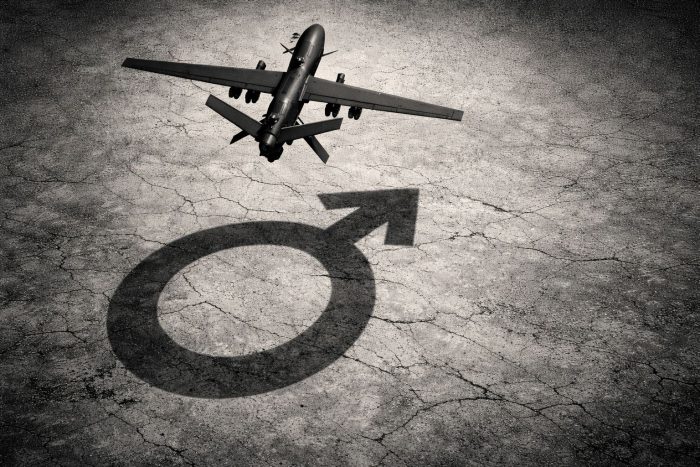
The reported rescue of a downed US airman in Iran, at least as is detailed by American Air & Space Forces Magazine, reads as a model of precision and heroic resolve.
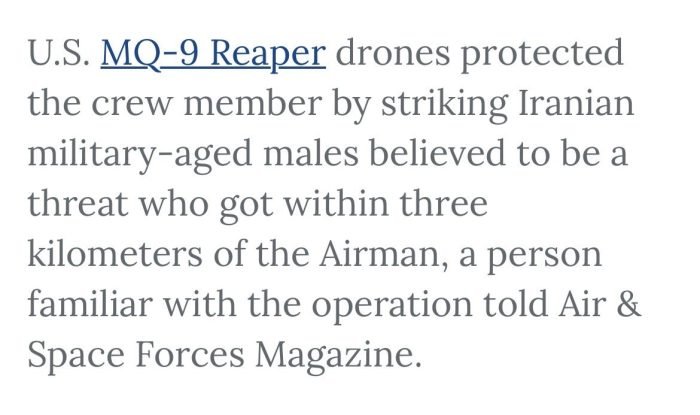
And yet – as is often the case with such things – one element of that account stands out unfcomortably. That is that drones struck “military-aged males” who were believed to be a threat and were within three kilometres of the American pilot. It is a concerning throw away line that speaks to a broad and troubling pattern in contemporary warfare that is not discussed in much detail and certainly not pivotal to debates about gender and conflict.
The trouble is that the targeting of ‘military-age males’ or ‘fighting-aged’ this is not an aberration. Rather, i reflects a deeply embedded practice, particularly in remote warfare, where categories such as “military-aged males” have been used both to justify targeting decisions and to shape how casualties are recorded.
As someone who has been following remote drone warfare since it began to take hold in post-9/11 campaigns across Pakistan, Yemen and Somalia, one thing has been clear: that US policy at times treated all military-aged males in a strike zone as presumptive combatants unless proven otherwise after death.
This did two things: it reduced official civilian casualty counts and shifted the burden of proof onto the dead. As one former official put it, such approaches amounted to “guilt by association”.
AOAV has always argues that this clarification obfuscates and prevents proper oversight by blurring the distinction between civilian and combatant. In so-called “signature strikes”, where individuals are targeted based on patterns of behaviour rather than confirmed identity, the reliance on such demographic assumptions can become self-reinforcing. Men of a certain age are treated as a threat; they are then killed. Their very death reinforces the idea that they were militants in the first place because – the assumption goes – highly trained militaries don’t kill civilians wilfully.
This, sadly, all goes to the heart of how modern conflicts are fought and understood. The expansion of drone warfare, now employed across multiple theatres by a growing number of states, has increased both the physical and psychological distance between those who decide to use force and those on whom it is used. In such environments, basic profiles such as gender and age are more than enough for strikes justification – and far more than the granular intelligence that international humanitarian law requires.
All of this has happened whilst the legal framework has remained unchanged.
The Geneva Conventions are clear: individuals may be targeted only if they are combatants or directly participating in hostilities.
In this regard, killing someone because they fit a demographic profile is a failure to meet that threshold. The truth is, though, such distinction is not tested in the law and it appears to be getting worse.
To be clear: “military-aged male” is not a neutral term. It enables a justification as to who can be killed in war. And it erodes the primacy of distinction in conflict.
The real challenge is finding people who are able and willing to defend these killed Iranian young men. Who will take their cases to court – especially as the missiles that were used to kill them cost far, far more than civil society has to hire lawyers to challenge their deaths.
In the end, there are two victims here: the young men killed by American drones and the foundational philosophy of a just and fair war. Because if war is fought without distinction of who is – and who is not – a combatant, then that war will always erode the principles of justice on which it was fought. As John Locke once wrote: ““Where there is no law, there is no freedom.”
The American’s claim to be defending freedom, just as it kills military-age males, seems to be on unstable grounds.
Did you find this story interesting? Please support AOAV's work and donate.
Donate