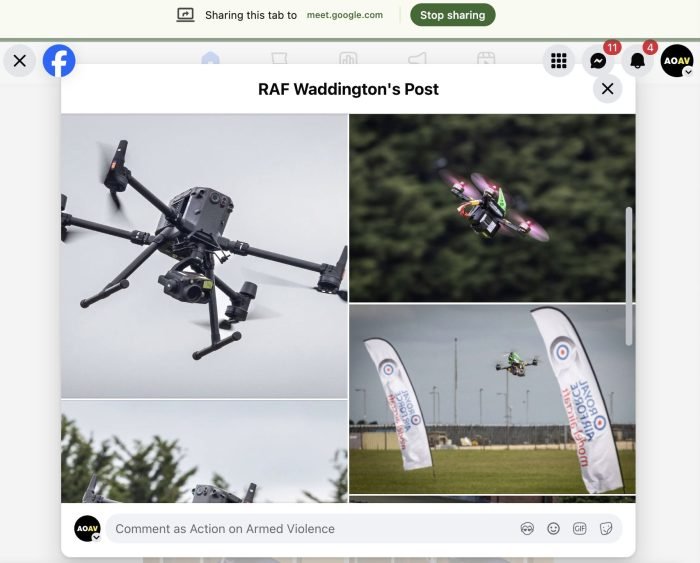
Images published by RAF Waddington have prompted questions about the role Chinese-made drone technology continues to play in military training and technology assessment, despite government assurances that the Ministry of Defence does not operate Chinese-manufactured drones.
Photographs shared on the station’s Facebook and Instagram accounts on 17 June show personnel attending a live drone demonstration as part of a Continuing Professional Development (CPD) event. RAF Waddington described the day as an opportunity to explore a range of uncrewed aerial systems and better understand developments in drone technology.
The images appear to show DJI-made platforms, likely either the DJI Matrice 300 RTK or DJI Matrice 350 RTK. DJI, a Chinese manufacturer, dominates the global commercial drone market and supplies equipment widely used by emergency services, infrastructure operators, surveyors and photographers around the world.
RAF Waddington is the Royal Air Force’s principal hub for intelligence, surveillance, target acquisition and reconnaissance operations. It hosts some of the UK’s most sensitive airborne intelligence capabilities and plays a central role in Britain’s surveillance and information-gathering activities.
In a caption accompanying the images, the station said: “Understanding these systems is vital to maintaining a safe operating environment for our conventional air assets.”
There is no evidence that the drones shown at RAF Waddington are being operated by the RAF as part of military activities. The station’s description suggests the event was educational and intended to familiarise personnel with technologies they may encounter in civilian and operational environments.
Nevertheless, the photographs are notable because they show Chinese-manufactured systems being examined at a time when the UK government has adopted an increasingly cautious approach towards Chinese technology in sensitive sectors.
The issue was raised in Parliament late last year. On 25 November 2025, Sir Iain Duncan Smith asked the Ministry of Defence whether any drones produced for non-military purposes and used by the department contained Chinese components. Responding on 12 December 2025 the Minister for Defence Procurement, Luke Pollard, stated: “The UK MOD does not operate Chinese-manufactured drones.”
Pollard added that supply chains are regularly reviewed to mitigate national security risks and that procurement officers making small-scale purchases outside standard acquisition frameworks must seek guidance from the Defence Uncrewed Systems Design Authority to ensure systems are secure, interoperable and suitable for military use.
The distinction between operating and studying a technology may be significant. RAF Waddington’s social media posts do not indicate that the drones were procured by the Ministry of Defence or used in operational roles. Rather, they appear to have formed part of a demonstration intended to improve awareness of rapidly evolving drone capabilities.
That evolution has accelerated dramatically in recent years. Commercial drone platforms have become increasingly sophisticated, incorporating advanced sensing, automated navigation and AI-assisted functions. Lessons drawn from commercial systems are routinely informing military doctrine, procurement decisions and battlefield innovation around the world.
Likewise, DJI (Shenzhen DJI Innovation Technology Co. Ltd.) has consistently rejected suggestions that its products present a security threat. The company says its enterprise systems can be operated offline, restrict data transfers and allow users to prevent connections to cloud services.
However, concerns about cybersecurity, data security and strategic dependence have led several governments to restrict the use of Chinese-made drones in sensitive environments. In the United States, the Department of Defense has imposed restrictions on certain commercial foreign-manufactured drone systems and has identified several Chinese technology firms as potential security concerns. The DoD 1260H List of prohibited entities includes several drone manufacturers, including DJI.
For AOAV, the significance of the RAF demonstration extends beyond the nationality of the manufacturer. Commercial drones increasingly provide the technological foundation upon which military AI, surveillance and autonomous capabilities are built. As armed forces seek to understand and integrate these systems, questions arise about where the boundary lies between familiarisation, adoption and reliance.
The rapid expansion of military interest in autonomous and AI-enabled technologies has also intensified international debate over accountability and civilian protection.
The UK has resisted calls for a legally binding international treaty regulating fully autonomous weapons systems, arguing that existing international humanitarian law provides an adequate framework. Critics contend that growing reliance on increasingly autonomous technologies risks reducing meaningful human control over decisions involving the use of force.
As Sahdya Darr, the Coordinator of the UK Campaign to Stop Killer Robots wrote in their evidence to Parliament: “Close scrutiny of the MoD’s AI strategy documents points to a deep conflict between the UK Government’s stated democratic values rooted in human rights on the one hand, and a technocratic impulse to race forward with AI at all costs on the other.”
The drones displayed at RAF Waddington were not armed and appear to have been used solely for educational purposes. Yet the event offers a glimpse into how military institutions are engaging with technologies that are reshaping modern warfare.
Perhaps, then, the question is not whether the RAF is operating Chinese drones, but why understanding commercial drone systems has become so important for one of Britain’s most sensitive military bases. And what that means, in the end, to the evolving nature of war.
For, in the end, what might begin as a testing product may well end as a lethal weapon whose harm is most intimately felt by civilians.
Did you find this story interesting? Please support AOAV's work and donate.
Donate